Friday, 26 June 2015

What is Structural Integration.....?

Quite simply......Structural Integration is an 'alternative' manual body work therapy to establish vertical alignment and horizontal balance in the human body.

Structural Integration (SI), also known as 'Rolfing', was pioneered by Dr Ida Rolf (hence the name) back in the 1950's. The main focus and purpose of 'Rolfing' is to re-align the entire body by manipulating and releasing restrictions in the soft tissue network (Fascia) that envelopes all our bones, muscles and internal organs.

You may have heard of other techniques like The Bowen and The Alexander Technique/s, which are similar body work therapies and methodologies that focus on proper alignment and posture. I'm sure they are great too.....any system that respects posture is going to be good for you and your body. But my focus and interest right now is around the work of Ida Rolf and the continued progression of her work by Thomas Myers with his 'Anatomy Trains', who himself studied under Dr Rolf.

So in one of my previous posts, I talked quite a lot about fascia and it's significance within our bodies. And it is this fascia (myofascia) that an SI practitioner will be working with when they go to work on your body. Not the muscles, certainly not the bones or joints, but the ALL important myofascia!

By releasing tensions in the fibres of this continuous fascial web/network, it will unlock the restrictions existing in the body (we all have them!) that have been pulling the bones out of their natural alignment, which then forces compensatory patterns in our muscles, which then leads to overuse and fairly predictable injury patterns.

The other really important and defining factor about SI to note, is that it is an entirely holistic approach to body work, from the toes to the head! Nothing is overlooked, the entire body will be assessed for dysfunction and treated as a whole unit, just like our bodies are designed to operate.....as one!

I am nearly two months into my journey of 'fixing myself', using The Power of Posture. It has been an amazing couple of months for me and there have been some incredible discoveries and progress in such a short time, but my plans have now changed slightly. I am learning new and fascinating things, literally on a daily basis and I have to evolve and progress with the discoveries I am making.

When I started out on this journey, my intention had always been to 'fix myself' by introducing a promgramme of specific and focused 'self myofascial release' (again, a topic I have discussed previously in this blog), along with some corrective exercises, mostly standing work, wall retractions for example, breathing exercises and some proper planking for good core activation. The basic idea being to unlock the restrictions in the connective tissue/fascia via self myofascial release, and then re-engage and activate the dormant muscles groups, like my glutes and TVA (core) for example, through the corrective exercises.

This was working really well for me, with some significant and noticeable benefits (as previously discussed), but honestly, doing it all by yourself is........well, to be honest.......really hard!! I don't mean from a motivational point of view, just from a practical stand point. The releasing part was/is easy for me and I connected with that aspect immediately and love it, even the 'sensations', it's really very powerful. But the all important corrective exercise part was the really challenging piece for me, this is what makes the changes stick and what will re-programme the correct neuro-muscular associations again to achieve naturally efficient posture and movement.

What I realised was, I really needed an objective and well informed third party to observe my body position for these corrective exercises, to make the very important yet very subtle corrections needed to get the full benefit from the exercises. It didn't take me long to realise that I needed some help!

My first port of call was Yoga. Standing poses, breathing exercises and plank! These three things really embody Yoga practice in my mind, so I thought it would be perfect to incorporate into my corrective programme. But....as amazing as Yoga is and I love to and will continue practice it, it was almost spoiling Yoga for me in a way. It kind of ruined the flow because I was thinking too much about the postural corrections. So, I knew I needed something else.......

My next plan, was to go and see someone at Functional Patterns (FP) London. Now I've not talked much about FP, but actually, I should more and will, because these guys are onto something amazing and are actually THE initial motivation for my postural correction! They (he - Naudi Aguilar) basically offers a more movement and exercise based approach to the ideas and principles of Structural Integration, including self myofasical release, but their primary focus is ALWAYS on posture and movement efficiency above anything else! So anyway, in the end, cost was prohibitive here....with London overheads etc, I was looking at 200 quid + including travel expenses etc for an initial consult. Whilst I am very happy to invest in my education, general health and well being, I have to be realistic here too and as I'm talking about efficiency a lot right now, that was certainly not going to be an efficient use of my hard earned cash!!

So I was a bit disappointed as I would have loved to go see these guys, but had to bin that idea!! Anyway........

There must be someone nearby who really understands what I am trying to do with myself (my body) and can help me achieve my goals........? Those goals simply being good posture and movement efficiency. A bit of looking about on the good ole' Google and I soon found.......

http://www.structuralbalance.co.uk/


Owned and operated by Angela Donovan, certified KMI practitioner and registered on the Board of Certified Structural Integrator (BCSI). Now this was someone fairly local for me (Leamington Spa) who can really help me and understand me, with very reasonable pricing, certainly when compared to other body work therapies I have had in the past.

KMI = Kinesis Myofascial Integration. Which is Thomas Myers' progression from the established practice of 'Rolfing' and encompasses the wonderful work and research into the myofasical meridians of his Anatomy Trains model. The principles are very much still the same, they work entirely with the fascia/soft tissue, but the practice has just been slightly refined based on new research and understanding of myofascia from dissections in the lab. Not to mention all his years of practical experience working on real people.

So I went for my first assessment session this week, having already exchanged a few e-mails and shared my blog with Angela...........

I'll keep the details short for now as I have gone on more than enough..... but I will be going back for more sessions. The full KMI process is 12 sessions in total, this is what it will take for her to unlock and unravel my body. I will be documenting this entire experience of this KMI process through my blog.

If you want to find out how I got on with the assessment and session 1, you will have to catch my next blog post..........'KMI Session #1 -  (Assessment and The Superficial Front Line)'

But until then.......thanks for reading! :)

#ThePowerofPosture
#StructuralIntegration
#KMI


Saturday, 20 June 2015

What is a 'good posture'......??

The ideal, natural and most efficient posture for humans (assuming no underlying genetic, bone or joint disorders/disease etc...) is actually quite straight forward to describe, visualise and understand.

Basically, we evolved to stand up straight on two legs and that is exactly how we should stand.....up straight!

Observed from the side, in the sagital plane, you should be able draw a straight vertical line down the side of our bodies, it should run through our ears, shoulders, hips, knees and ankles, in perfect alignment.

From the front, in the coronal plane, you should be able to draw a vertical centre line through the belly button and nose (or down from the shoulders, as in the example below running again through the hips, knees and ankles) and then perpendicular lines across the shoulder, hips, knees and ankles.

Something like this....


Simple right? But yet, it still seems to be massively overlooked as a really important factor in our general health and well being. Perhaps THE most important factor, at least that is my increasing believe based on my research and discoveries with my own body so far.

If we cannot hold ourselves and stand with a natural and upright posture because of underlying restrictions and bio mechanical dysfunctions in our body, then how can we expect to function in life without injury and pain, at our maximum efficiency and potential?

When we add movement into the mix and start considering the 4th dimension of time and our movement through it, the dysfunctions seen when standing are exasperated and will cause compensatory muscles patterns to occur when in movement, meaning our muscles are not all operating on their primary function/s or at maximum efficiency.....

"Establish movement quality first!.......Then increase volume, intensity and complexity, without every compromising the movement quality which you first established." Erwan le Corre (MovNat)

Tight calves and tender ankles/feet for example (I certainly do).....quite likely could be caused from over use of the associated muscles because of muscle compensation from an underlying postural dysfunction. So if for example, our natural posture has some sort of forward lean/tilt from the pelvis (which seems to be quite common in today's society), then the upper body is not being properly supported and balanced ('stacked') above the hips. Therefore, we have to compensate with other muscles to support our structures and remain upright and that is likely the cause of tight calves, from over use.

Tight next and shoulders.....could well be caused from our head 'slumping' forward from our 'centre line'. The head is then not being properly supported by the spine, so muscles in the back and neck have to compensate to support our head and hold it up. This then causes over activation of the muscles in our back and neck, followed by tightness and restriction in that area. This forward slump is actually making our heads weigh a lot more than they should.....see below....


I am very much simplifying things here, I know....but hopefully you get the simplified picture that I am trying to paint of muscle compensations that can be caused from postural misalignment.

According to James Earls and his fascinating research into Myofascial Efficiency and the Body in Movement, one of the hallmarks of efficient walking is the absence of active muscular contraction, maximizing the recoil efficiency of the fascial tissues.


So how and why do humans develop poor posture............??..........well I think I'll leave that as a topic for discussion and consideration in a future blog! :)

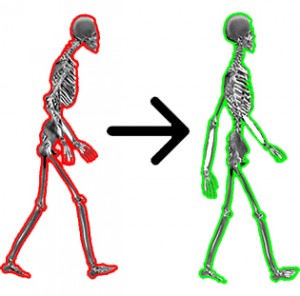
I'll just leave you with some images of postural corrections from Structural Integration body work, also a topic for a future blog!


Wednesday, 17 June 2015

Relieving cramp in my feet.....

So in my previous post I talked about some of the 'gains' I have already experienced from the work I have been doing on my body thus far to improve my posture, breathing and movement. The biggest and most significant gain for me so far has been curing a life long and fairly common cramp in my toes when extending my feet and pointing my toes, along with the benefits that come with this relieve, as previously stated.

I can remember being as young as 10-11 years old, swimming in the school pool and suffering with this cramp in my feet. I have always just kind of lived with it, as many of us do just live with these sort of mild complaints and dysfunctions around our bodies. It didn't really cause me any major pain or discomfort, I could always relieve it by stretching my feet/toes back against the cramp (in this case, flexing my feet/toes) and as long as I didn't point my toes again too much, it would be fine. I would be causing a shit load of drag in the water though.....but I really didn't appreciate that back then!

That's not to say I haven't tried to intentionally prevent/cure/relieve this cramp before. I have googled the matter several times and it's always the same ideas being presented, dehydration, sodium and potassium deficiencies for example. Muscle fatigue/tiredness. And I tried all this, drinking more, taking on electrolyte drinks, eating more bananas etc.................Did nothing for my cramp!

Never once in all my googling did I find........ 'you may have cramp in your feet because of restrictions in your Superficial Front Line'. (One of my next blog posts will explore our Superficial Front Line in a bit more detail.)

As it turns out, that is what I had (and still have!). I am still nowhere close to being 'fixed' and free from restrictions in my body yet, I am just becoming increasingly aware of these restrictions. But I am making some real progress and amazing discoveries, relieving this life long cramp being the most amazing discovery so far. I never set out to relive my foot cramp, but it was gone within 5 days of starting my programme.

So, how did I actually relieve this cramp? Actually, it was very easy. I just released my TFL!

The Tensor Fascia Latae (TFL)


As you can see above, the TFL is a small muscle that originates in the pelvis and, along with other muscles attaching to the pelvis, is primarily responsible for hip flexion, bending our knees. The connective tissue for this muscle runs down through our IT band (connective tissue down the side of our legs), increasing tension in this band to help stabilise the knee, and attaches at the outer portions of the tibia, just below the knee. Again, see above.

Just as a side note....this muscle is chronically overactive when we are sitting down for extended periods! See, my previous post on The Problems with Sitting.

So anyway, there is a self myofascial release technique you can apply to the TFL to help reduce tension and tightness in the body. In the feet as it turns out. I introduced the concept of self myofascial release in my first vlog last week, if you wonder what I am talking about, please look it up. Either watch my video or just do some googling.

But this TFL release is what relieved my cramp...just that! Nothing else!! Amazing, don't you think?

Now I had planned to do my own instructional video on how to release your TFL......but, I am a bit pushed for time this week and there are plenty of other people who have done a really great job of demonstrating and explaining this release already, so I'm just going to hook you up with a YouTube link........

As you will note, the title of the video suggests this as a relieve for lower back pain and I would have to agree with that as well. As well as relieving the cramp, it has also reduced tension in my back, virtually eliminating any discomfort/pain.


Whoever you are....however you life your life and whatever you do, I seriously recommend you try this release. Purely because I do not have the writing skill or vocabulary to properly describe the experience for myself. All I can say is, WOOWWW!!! (that a very big WOW, by they way. Like I said, I just don't have the vocabulary or adjectives to properly describe it and do it justice) The first time I lay my TFL down on a lacrosse ball (maybe start with a tennis ball) and relaxed into it, the sensations travelling through my entire body just lit me up. Strong electrical impulses traveled from my toes to my head, I could feel the whole TFL and connective tissue just light up in my body, the entire 'Superficial Front Line'. It was literally that....a total light bulb moment! Not just physically, but emotionally!! Seriously powerful stuff.

If you do try this out, I would be really interested to hear about your experiences. I just found it such an amazing way of connecting with my body....and mind! I know that I cannot be unique in that regard.

#ThePowerofPoster
#ThePowerofSMFR
#TFLrelease


Friday, 12 June 2015

Some huge gains already......

I have been applying The Power of Posture to my body now for 6 weeks. This has basically meant getting down with a daily and specific self myofascial release and stretching routine, with some abdominal breathing and yoga thrown in for good measure.........anyway.....I won't bore you with all the details in this post! There's plenty more posts to come on that in the future! ;-)

But, for my own records, I just wanted to briefly summarise the benefits I have already gained from applying this practice to my body at this 6 week mark.......
  • I have cured a life long and quite common cramp in my feet when extending my feet/pointing my toes. This only took a few days of release on my TFL and was never something I specifically set out to cure. This was the real defining and life changing moment for me to be honest!
  • The relieve of cramp in my feet has enabled me to perform some deeper hip flexor stretches without actually bringing on the cramp. All helping to open up my hips.
  • When swimming, I can now get much longer in the water and really point my toes. Swimming would often bring on cramp, causing drag from my feet in the water trying to prevent it, that is now gone!
  • This morning, I swam a sub 4 minute (3:57) 200 metres for the first time EVER!! It was not a big perceivable effort either. I was genuinely shocked when I stopped my watch! That's over ten seconds faster than what I was swimming last year, when I was 'in training'!
  • I am not any fitter, I can't be! I spent the first 4 months of this year doing very little training whatsoever.....I am just more efficient! This makes me faster for free!! Bonus :)
  • I have relieved lower back strain and tension which in turn has virtually relieved the lower back pain I was occasionally experiencing. Especially in the mornings.
  • I have lost a stone in weight and am under 17st for the first time in AGES!! But weight loss is NOT my motivation here at all! It's just another metric that can be considered.
  • Then there is the emotional aspect. Well, I have never been more inspired in my life! I even started a blog! WTF!!!
  • I feel GREAT!!!!!!!!!!

The benefits that the next 6 weeks could bring for me is very exciting..... Sub 8 minute 400 metres maybe? We'll see. I'm only just getting started here and I have a very, very long way to go yet!


#ThePowerofPosture

****ADDENDUM 15/6/2015****


  • A litte more effort in the pool this morning and I swam 200m in 3:46!!


Thursday, 11 June 2015

An Introduction to Self MyoFascial Relase - SMFR

Finally managed to get around to my next blog post.......so I decided to deliver this message via a video log or 'vlog'. I actually started to write it up to begin with, but soon realised I was describing a lot of props I have around the house that I am using on a daily basis, so thought it might be a better idea to record a video so I can show you these 'devices' I am using for SMFR. It is also a good opportunity to not be sitting at my desk, which is always a bonus! :)

So here it is.....my very first Vlog....hope you enjoy and find of some interest......

The embedded video below is a little small for some reason, but you can click on the link below to take you to the YouTube page with the full size recording.


Thanks for watching! :)

Monday, 1 June 2015

'Fascia' and it's significance within our bodies....

A couple of years ago I suffered a pretty minor, but irritating and uncomfortable, shoulder injury damaging my bicep tendons, which attach at the shoulder. It was caused from over use/exertion doing (or attempting to do) too many high intensity press up and tricep dips. By the way.....I now consider tricep dips a terrible exercise as the position adopted to perform the exercise puts the shoulder joint and connective tissues under a great deal of pressure and actually in a very weak position that has no context in real life movement patterns, yet they remain very popular within the fitness industry. It is also attempting to train a specific muscle in isolation. But anyway, that's not the point of this post.......but maybe it should be a future one...??..sorry, I digress.....back to the point......

So this shoulder injury I suffered really made me re-think my whole approach to my training and my body. I started investigating the problem a bit for myself and during the course of that investigation, I stumbled across the topic of  'Fascia', often refereed to as 'Myo (muscle) Fascia', but it is much more than just that. Now it was actually a course of physio therapy and a specific rehabilitative weights programme that got my shoulder back to strength in the end, thanks to Lauren at Peak Performance :) But my interest in this connective tissue called 'Fascia' had kind of been sparked and I have continued to research the topic, just really as a matter of personal interest since then.

So...............What is Fascia?

 “Fascia is your body’s soft-tissue scaffolding. It provides the matrix that your muscle cells can grow upon and it also envelopes, penetrates and surrounds all of your joints.” 

The above quote sums it up very nicely for me, but I will break that down and explain it in a bit more detail, based on my own understanding.

Fascia is basically an elastic and continuous three dimensional web/network of soft connective tissue that surrounds all our muscles, joints, bones and internal organs within our bodies. An interconnected matrix of fluid elasticity. It is what holds us together as one unit, as a fully integrated system, connecting all our muscles, tendons and joints, including our bones and skeletal frame (but more on that shortly).

The Facial Web (magnified 25x)


In my previous post, I described the problems with sitting which can and will cause a shortening in our hip flexor muscles (among other things), with the consequences I previously described. Well, now consider this....it is not actually a limitations in the muscle itself which is restricting movement and full extension of the hip flexors (for example), but the surrounding and connecting Fascia that has become bound tight and knotted, loosing some of it's natural elasticity. It is this Fascia, which is directly attached and in entwined within our muscles (and everything else internally) that is actually restricting the movement by causing a shortening of the attached muscles. The muscles are simply not being allowed to fully extend and are restricted by the surrounding tight Fascia.

The idea behind the system I am adopting to 'fix my body' is actually to release this tight/knotted connective tissue or Fascia, starting around the hips, which in turn releases the attached muscles allowing them to properly return to their full length when under extension, allowing my body to naturally return to it's default setting of natural posture and efficiency. This technique is called Myofasical release, or in my case, Self Myo Facial Release, (basically, it is just giving yourself a good massage, but in very specific places) and that will be the topic of my next blog as I go to work on my body, systematically using this technique in combination with some basic corrective exercises. But for now....more on the The Fascia itself........

In the classically taught picture of the human body, we are taught that bones provide the supporting structure and stability to our bodies, but this is only partly true. Muscles keep bones in place and provide movement (at least the second part is true). Ligaments attach bone to bone, tendons attach bone to muscle. Full stop, end of sentence!! I even remember that from GCSE PE at school (must have been on a day that I wasn't bunking off), but there was never any mention of Fascia or connective tissue beyond ligaments and tendons, even in the classes that I didn't attend! It is very much a dissected (literally dissected, early anatomical dissections just cut away the Fascia to get to the individual muscles), isolated and I'm sorry to say, very outdated view of our bodies that seems fundamentally flawed to me when it does not consider, not even slightly, the role of the Fascial Network in muscle development and movement.

There is actually a train of thought and debate among academics and body workers that tendons and ligaments should be and are also classified as 'Fasica', as it is an integral part of this soft tissue network surrounding our internal structures. Bones even as well, but that is all getting a bit deep and way beyond my current levels of reading and understanding for now! And I am clearly no academic!!

But from the reading I have done so far, it is my increasing understanding and believe that the bones are actually NOT the main supporting structure of our bodies. It is really The Fascia that binds us together, holding us upright, retaining and distributing fluids throughout the body, providing lubrication and elasticity/flexibility for the muscles and aiding our posture, flexibility and movement. The bones are really acting as spacers, determining the proportions and correct spacing of the structure. It is The Fascia that is actually the complete connective and supporting structure, a structure of tensile integrity, or 'tensegrity', creating pulling forces of tension around our bones and muscles, supporting our bodies and movement patterns, supporting our bones as they 'float' within this tensile structure!

Controversial, maybe.....?? Apparently it is! According to the reading I have done so far and the fact it seems to be completely overlooked by our education system, I have checked GCSE and A level anatomy pages and the Fascia is still very much cut away, with the exception of ligaments and tendons. But I can't really understand why it would be so overlooked and controversial to be honest!? Because to me, certainly in the context of my own body and the discoveries I am making, this 'new' (not actually that new) train of thought makes perfect and total sense to me!

The following image shows a Tensegrity Structure. 


The connective rubber bands can be compared to the biological 'Fascial network' of our bodies and the rods to our bones. You will note that the rods are not actually touching one another, just like our bones do not really touch one another, yet they are supported within the structure and are able to move around in it, but only within the limitations/restrictions of the rubber bands movement. The rubber bands are what is actually providing the support for the structure, not the rods. If you cut away the rubber bands, gravity would win!!

The other observation you can make from a tensegrity structure as shown above and when compared to the human structure and fascial network......If you had this structure in your hands and could move it around, you would see how moving one part of the structure creates and influences movement patterns all through and around the entire object, because it is all part of the same connected structure. Just like this 'Fascial Network' in our bodies. I talked in my previous post about everything being connected and treating nothing in isolation......this is exactly why!

I have mentioned a few times now about tight and knotted Fascia and how it can restrict the movement of our muscles through their full range of motion.......but what causes this tightening and restrictions within the Fascial Network?

Actually, it's just life!.......and certain life choices as well. Here are some examples.....
  • Physical stress or trauma, like a road traffic accident or injury
  • Giving birth
  • Surgical procedures and repaired scar tissue.
  • Broken bones, torn muscles, ligaments, tendons etc....(probably torn because of other Fascial restrictions in the first place and poor inefficient movement patterns).
  • Emotional stress, from home/work, depression, or bereavement etc.
  • Dehydration! The Fascial Network is really a matrix of hollow fibres that are full of gel like fluid! It must be well hydrated to work efficiently and retain its flexibility.
  • Repetitive, isolated and loaded static movement patterns, e.g. back squats, deadlifts, dips, push ups, chin ups, "legs days". (We don't use our legs in isolation, so why train them in isolation? Think about it.......)
  • Overexertion, or over/under activity of isolated muscle groups, like when sitting down.
  • General lack of movement
Some of these things we cannot control. Some things we certainly can, but only if we are aware of the potential problems/dysfunctions that we could be unintentionally creating and building upon within our bodies. Take sitting down for example, with an awareness of the dysfunction that this daily activity causes within the body, you can intentionally take some very simple steps to address the problems. For example, if you have a sedentary job or are just a lazy sofa bum, maybe both! Being aware of the damage that you might be doing to yourself can help you take some corrective actions, simple things like just standing up periodically, every 30 - 60 minutes, stand up, walk about, have a stretch, practice yoga/pilates or have a general stretching routine! All of this will really help keep the bilogogical Fascia of the body, and everything it connects with, in good condition. To a certain extent, everything else from there should take care of itself, good posture, better breathing, better movement, less injury risk.....sounds to good to be true right!? Oh....and drink plenty of water! But we all know that anyway, right?

For me personally (and quite likely for a lot of others as well), the problem is slightly more deeply rooted in my body and deep in my Fascia, so although I am already adopting better practices when sitting at my desk for example, like standing up more frequently and also just being more aware of how I am sitting, even considering a rise-able/stand up desk. I've also dropped high intensity resistance exercise/training and that's all good stuff to be mindful of, but, to make proper gains in improving my self and becoming more efficient, I must retrain my Fascia and get that elasticity/flexibility back into the fabric of my body. By getting rid of the knots causing blockages, releasing the fibres, restrictions and dysfunction in the body and open my self up! In doing this, I can then reactivate dormant muscle groups that should be helping me breathe, stand and walk/move with efficiency and without compensations. That is the plan at least anyway.

People, especially in the fitness industry, talk a lot about 'functional training' programmes but without ever really considering these three key life factors first! Breathing, standing and walking!! Yoga and Pilates are an obvious exception. Tai Chi as well of course, but these are practices, systems even, and aren't based around building a body image or ego, they are based around physical and emotional 'well being'. But it's generally about a bikini body/beach body, loosing a few pounds, or ripped abs, or big shoulders or lifting more.....whatever, it's about some sort of body image or trend or an image in a magazine. Breathing, standing and walking is just not cool enough!

I think I have emptied my brain on pretty much all I have learnt and understood to date about our amazing and wonderful biological fabric called 'fascia', if you are still reading this, I hope you found it of some interest, it has certainly sparked an interest in me and I have sooo much more to learn and discover about this.

I will leave you with this short video clip. It is a histology video of our fascia at 25x magnification. This short clip with accompanying subtitles totally blew my mind!!.....enjoy (perhaps not while eating though!)


Sources of reference:
The World Wide Web
'The Endless Web - 'Fascial Anatomy and Physical Reality' - R. Louis Schultz, Phd, Rosemary Feitis
'Anatomy Trains' - Thomas Myers
'Born to Walk' - James Earls
'The Power of Posture '- Naudi Aguilar


All of the above books are based on and expanding on the structural integration practices of Ida Rolf (Rolfing). I have not read anything directly by Ida Rolf herself yet, but understand her work to be the source of inspiration in the topics that I am researching. 

Thomas Myers studied under the guidance of Ida Rolf.

R Lois Shultz and Rosemary Feitis are both 'rolfers' and James Earls' work on walking efficiency is based entirely around the work of Thomas Myers and his 'Anatomy Trains'.

Naudi is The Man for movement! And it is his system, based on all of the above, that I am adopting to fix my body.


Wednesday, 27 May 2015

The problem with sitting!

Firstly, thanks to all who have read my ramblings thus far. I really didn't expect anyone to read it!

I was going to write up an introduction on Myo (Muscle) Fascia, Self Myo Facial Release (SMFR) and the Hips, based on my understanding of these things so far, and I still am. But after re-reading my introductory post, I realised I talked a lot about causing dysfunction in my own body from sitting down a lot, at work, in the car, on my bike, etc, but I never really explained why sitting down for extended periods of time is not very good for our bodies, and that information is kind of important to really understand this blog going forward and the purpose of the corrective actions I am going to be taking to fix my body!

What is the problem with sitting down?

Well, quite simply, it is just not what our bodies were designed to do! The topic of evolution and the change in our movement patterns from four limbs onto two is a little beyond the scope of this blog, but it is very relevant. Basically, we evolved as a species to be able to stand and walk/run upright, supported and balanced on two limbs. It enabled us to move, hunt and gather much more efficiently and ultimately to survive! Sitting down was never part of the evolutionary process....well, not until the 20th century at least anyway!


So, what happens to our bodies when we sit? Well, being in a seated position, especially for extended periods, creates muscle imbalances in major muscle groups that connect to our hips. The first significant group of muscles to be affected is the hip flexors. The hip flexors are a group of muscles that directly attach to the pelvis and are responsible for 'flexing' the hip, i.e. bending our legs. I will be drilling down into the hip flexor complex later on as I start 'releasing' those muscles, but for now I will just refer to them collectively.

So when we sit at a desk, or in our cars, wherever, our hip flexors are active (over active in fact), they are constantly shortened and in a state of flexion as our legs are bent. Over time, this constant activation and shortening of the hip flexors starts to have lasting effects and the hip flexors become shorter/tighter in general, until your muscles can no longer fully extend and return to their full original length when you stand up. We are evolving to sit!

This tightness and shortening of the hip flexors will force a forward tilt in the pelvis (Anterior Pelvic Tilt) when your hips are extended and you are in a standing position, this then has the knock on effect of lengthening and over extending the lumbar spine, causing a slight curve, weakness and under activation of muscles groups in your lower back, predictably leading to lower back pain/discomfort. I forget which law exactly, but as Newton said, "for every action, there is an equal and opposite reaction" and in my mind these forces are certainly at play here!

There are of course other muscles at play (or not) when we sit, like the glutes, and abdominal muscles. Properly activated abdominal muscles are going to be absolutely key to maintaining a good posture, so that they can properly support the spine, but I'm just going to leave it there for now with the hip flexors. It all really starts at the hips and these muscles are going to be my initial focus.

I'll be spending quite a bit of time working on correcting my hip imbalances before I move on to the lower extremities. I'll get to the abs eventually, but there is a chain, a sequence if you like that I have to follow to unlock my body and properly address my postural deficiencies. This is a holistic system I am applying here and considers the whole body as an integrated system, nothing will be treated in isolation, everything is integrated and connected, so the sequence that I follow is very important. For example, it would be pretty pointless to start addressing imbalances in my calves and feet (which I certainly have), before I have fixed my hips!